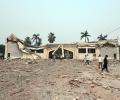
'Every decision India makes along the LoC, it must also consider implications along the LAC.'
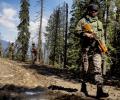
Pakistan has warned the international community that any military moves by India shall be 'responded to assuredly and decisively... onus of any escalatory spiral and its consequences shall squarely lie with India.' Implicit in the statement is a veiled threat that even a nuclear threshold may be reached if push comes to shove, warns Ambassador M K Bhadrakumar.
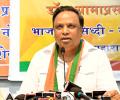
Amid violence against Hindi-speaking people, Maharashtra minister and Bharatiya Janata Party leader Ashish Shelar on Sunday drew parallels between the Pahalgam terror attack and the beating of 'Hindus' in Mumbai, which he said is condoned by some leaders.

Some pro-Kashmir resistance handles on social media have claimed that the citizens who were injured in the Pahalgam terrorist attacks were not 'ordinary', but connected with internal security and counter-intelligence agencies like the Intelligence Bureau (IB).
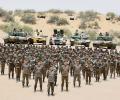
He also reviewed the joint actions undertaken in coordination with the Indian Air Force and the Border Security Force, they said.

More than 118 Pakistani forward posts and their surveillance system were completely destroyed by the BSF during Operation Sindoor, dealing a major blow to the neighbouring country, Union Home Minister Amit Shah said on Friday.
In the India-Pakistan situations, off-ramps have come either through foreign mediation (after months of kinetic warfare over Kargil, and a long stand-off with Op Parakram) or when a situation made it possible for both sides to claim a win, explains Shekhar Gupta.

India on Sunday said it inflicted tremendous losses to the Pakistan military, including downing its fighter jets featuring latest technologies and damaging key military installations close to even capital Islamabad, during the three-day confrontation between the two sides.

Amid a storm surrounding his collaboration with Pakistani actress Hania Aamir, singer-actor Diljit Dosanjh has taken to social media with a cryptic message.

'Fears in Washington began to intensify when it was realised that subsequent Pakistani and Indian attacks on major military facilities -- which were significant in terms of geographic scope and intensity -- could rapidly take both sides to where neither actually wanted to go.' 'The US objective was to stop the fighting as soon as possible. Everything else was secondary.'
Officials have also written to the Pakistan side regarding the medicines, an official statement said.

India agreed to give up the Poonch salient as well as Uri. To the north India also proposed to give up land in the Gurez sector giving the entire Neelam/Kinshanganga valley to Pakistan. In return India sought control of the post dominating Kargil town, points out Colonel Anil A Athale (retd).

The Congress on Monday distanced itself from the controversial comments of some of its leaders on the Pahalgam terror attack, saying that only the recent CWC resolution and the views expressed by AICC chief Mallikarjun Kharge, Rahul Gandhi and authorised AICC office-bearers represent its position. The opposition party's assertion comes in the wake of remarks by leaders like Vijay Wadettiwar, Mani Shankar Aiyar, Shashi Tharoor, Tariq Hameed Karra and Saifuddin Soz that have triggered a row, with the BJP alleging that some from the opposition party were speaking "Pakistan's language".

"It is still not too late. India must speak clearly, act responsibly, and use every diplomatic channel available to defuse tensions and promote a return to dialogue in West Asia," Gandhi asserted.

'It brings precarious peace because the red lines have shifted. 'The next Pahalgam attack would mean a full scale war.'

India has suspended the Indus Waters Treaty with Pakistan, citing sustained cross-border terrorism and security concerns. The treaty, brokered by the World Bank in 1960, governs the distribution and use of the Indus river and its tributaries between the two countries. India's decision follows a recent terror attack in Jammu and Kashmir, and has been met with strong condemnation from Pakistan.
India registered its protest at the board of IMF, which met on Friday to review the EFF lending programme for Pakistan.

Gavaskar, widely regarded as one of the finest batters to have played the game, recalled how, as a teenager, life during the war was shaped by constant caution and national solidarity.
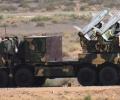
India's indigenously developed 'Akashteer' air defense system performed exceedingly well during 'Operation Sindoor,' according to Defence Research and Development Organisation (DRDO) chief Samir V Kamat. The fully automated system, deployed against terror sites in Pakistan and Pakistan-occupied Kashmir, integrates various radar systems, sensors, and communication technologies. Kamat expressed confidence in the system's success drawing international interest, highlighting India's progress toward self-reliance in the defense sector. He also addressed the future of warfare, emphasizing the need for a blend of traditional and emerging technologies, and outlined the development timeline for the indigenous 5.5-generation stealth fighter aircraft, the Advanced Medium Combat Aircraft (AMCA).

During Operation Sindoor, Indian naval ships, submarines and aircraft were operationally ready and deployed, projecting strength and preparedness to deter any "potential actions from our western adversary" in the maritime domain, Navy chief Admiral Dinesh K Tripathi said on Friday.

A senior government official confirmed that after a meeting with other stakeholders, the decision has been taken and airlines and airport authorities have been informed about it.
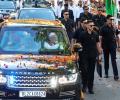
'It is important India to stay focussed on its primary national objectives: Combating terrorism; not losing sight of other security and strategic concerns (on the Sino-Indian front for instance); ensuring a strong economy and registering growth which includes improving the lot of common people; and finally making certain that the social fabric remains intact and harmony among people is not jeopardised, at least any further,' asserts Nilanjan Mukhopadhyay.

The Delhi High Court has ruled that an undertrial's prolonged incarceration cannot be a reason to grant bail in terrorism cases, emphasizing the gravity of such offenses and their potential to destabilize the nation. The court denied bail to separatist leader Nayeem Ahmad Khan in a terror-funding case involving Lashkar-e-Taiba (LeT) and 26/11 Mumbai attack mastermind Hafiz Saeed. The court considered the accused's argument regarding a prolonged trial and his right to liberty but emphasized that the serious nature of the crime, with its potential to disrupt national unity and create fear among the public, outweighs the length of incarceration. Khan, who was arrested in 2017, has been accused of conspiring for secession of Jammu and Kashmir through terrorist activities, receiving funding from Pakistan, and organizing anti-India rallies and demonstrations. The court highlighted the evidence, including witness statements and documents, supporting the accusations against Khan.
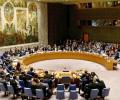
The United Nations Security Council held closed-door consultations on rising tensions between India and Pakistan, with envoys calling for restraint and dialogue. The consultations, requested by Pakistan, lasted for about an hour and a half. UN Secretary-General Antonio Guterres expressed concern over the tensions, urging both countries to avoid a military confrontation. India's former Permanent Representative to the UN, Syed Akbaruddin, said that no consequential outcome could be expected from the discussion.

"We're deeply grateful for the swift coordination and support from the BCCI, local authorities, and the police who made this possible," the RCB statement added.
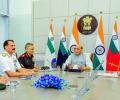
'Looking at how quickly the hostilities were escalating, the nuclear threshold did not seem that far.'
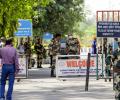
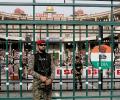
Abdul Waheed was brought from Srinagar by the Jammu and Kashmir police for his repatriation to Pakistan.

Defence attaches of several major countries who are part of many international groupings, as also of several Islamic countries attended the briefing, sources said.
A team from India's National Investigation Agency (NIA) has reached Pahalgam in Jammu and Kashmir to assist local police in investigating a deadly terrorist attack that killed 26 people, mostly tourists, on Tuesday. The NIA team visited the site of the attack, Baisaran meadow, known for its scenic beauty. Security agencies have released sketches of three suspected Pakistani terrorists involved in the attack, identified as Asif Fauji, Suleman Shah, and Abu Talha. The Resistance Front (TRF), a shadow outfit of the Lashkar-e-Taiba terrorist group, claimed responsibility for the attack.
'India enjoys conventional superiority, but nuclear deterrence imposes clear boundaries.'

The Director General of Air Operations said "whatever methods and whatever means we have chosen, it had the desired effects on the enemy targets",
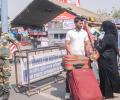
Sana, an Indian woman married to a Pakistani doctor, was forced to hand over her two young children to their father at the Attari border due to visa restrictions imposed by the Indian government following a terror attack in Jammu and Kashmir. Sana, who entered India on a 45-day visa, is unable to return to Pakistan as she is not yet a Pakistani citizen and the process could take another four years. The Indian government revoked the visas of Pakistani nationals on Short-Term Visas, leading to the separation of families at the border.
'It could take the form of sporadic LoC violation through heavy artillery and mortar fire, focusing on border villages where the Hindu Dogra population is predominant.'

Addressing a massive Martyrs' Day rally in Kolkata, Banerjee gave a clarion call to defeat the Bharatiya Janata Party in the 2026 assembly elections and eventually oust it from power at the Centre, declaring, "If this linguistic profiling doesn't stop, our resistance movement will reach New Delhi."
